Made Monstrous
On sovereignty, agency, and what happens to the women, divine or otherwise, who refuse to be classified

.
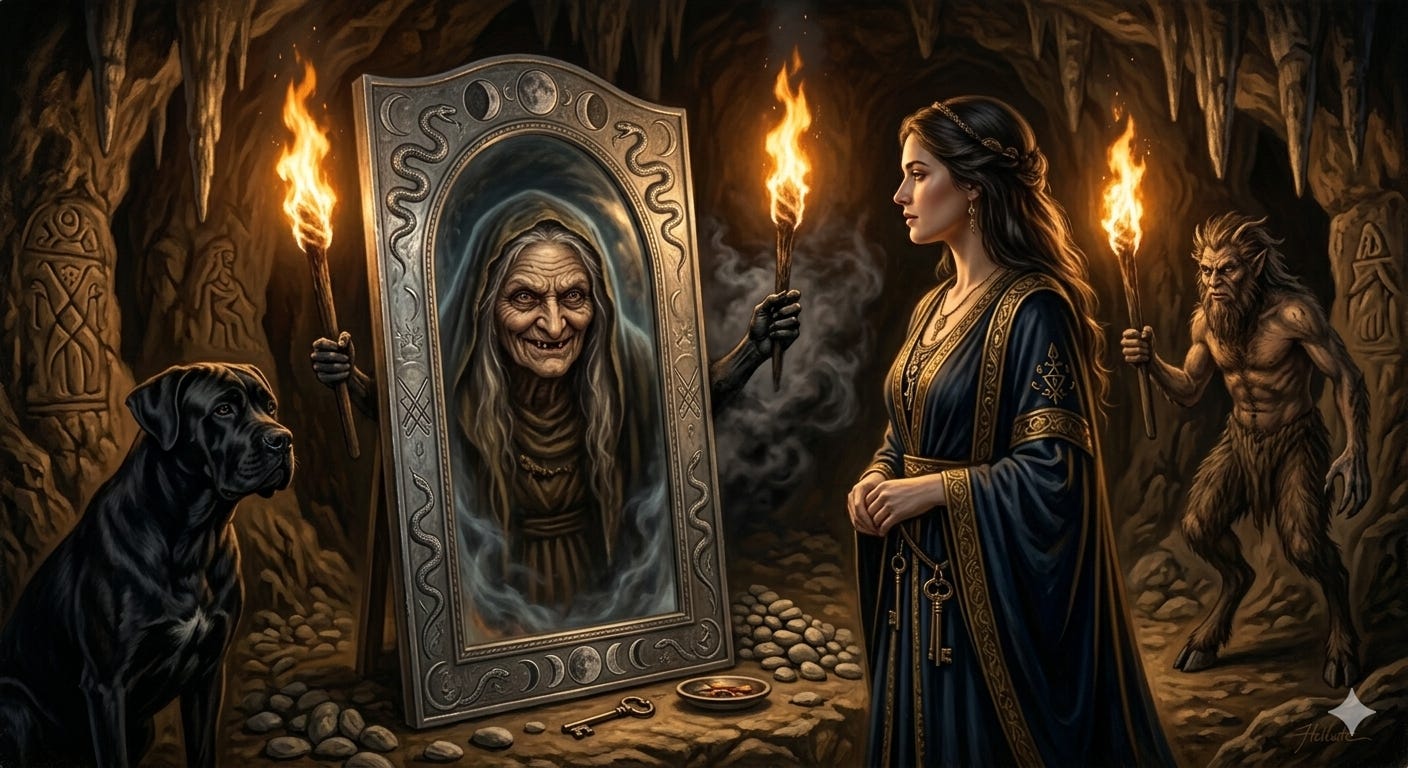
Somewhere between Hesiod and Middleton, a goddess of extraordinary sovereignty became the queen of a midnight coven. She acquired the cauldron, the serpents, the company of the howling dead, and a permanent association with the kind of magic that respectable people preferred to pretend did not happen. She became the witch goddess: thrilling, theatrical, and safely categorised as belonging to the dark side of a very tidy binary. What tends to get lost in that categorisation is the distance travelled from the beginning of the story to the end of it.
I have spent enough years working with Hekate to have developed strong views on this, and I want to distinguish two things: the chthonic aspects of her nature are real and genuinely hers. The crossroads at midnight, the company of the unburied dead, the torches that illuminate rather than comfort, these are not inventions of a later tradition, and I would not wish them away even if I could. What I am interested in is something different: not the chthonic qualities themselves, but the point at which they became the whole story, the moment the catalogue of her attributes narrowed from something almost impossibly broad to something that could be registered under a single heading.
The Hekate of Hesiod’s Theogony, written around 700 BCE, is one of the most striking figures in early Greek religious thought, and not because she is frightening. What is conspicuous about her is her scope. Hesiod describes Zeus as having honoured her above all others with a share in the earth, the sea and the sky simultaneously, a breadth of domain that no other deity can equal (Hesiod, c.700 BCE, trans. Most, 2006). She is not Zeus’s daughter. She is not anyone’s wife. She holds her authority as a titaness, something pre-existing the Olympian order rather than as a concession granted within it, and the passage in which Hesiod describes this has the quality of a treaty between powers rather than a father’s indulgence of a favourite child. There is no cauldron. There is no midnight. There is no company of the howling dead. There is, instead, a goddess whose domain is essentially unlimited and whose authority answers to no one. The Homeric Hymn to Demeter, composed perhaps a century later, gives us a Hekate who is already moving in liminal spaces, from her cave Hekate hears Persephone’s cries at the moment of her abduction, she carries her torches to Demeter, she accompanies the search, and she becomes Persephone’s companion in the underworld after the girl’s partial return. Hekate’s role is one of witnessing, purposeful presence rather than nocturnal menace.
The sanctuary at Lagina in Caria, in what is now south western Turkey, adds another dimension that the literary sources alone cannot supply. The Lagina inscriptions record a Hekate who is a civic patron, the guarantor of public ceremonies, the presiding authority over the sacred key carried in public procession through the streets of the city (Laumonier, 1958). She was invoked by magistrates. She was present at the turning points of communal life and children were named after her.
The Chaldean Oracles of the second century CE would present Hekate as the World Soul, the animating intermediary between the transcendent and the material, and the Neoplatonists such as Iamblichus, Porphyry, Proclus would describe her as the Soteria saviour and the anima mundi who protects and guides the soul on its ascent (Majercik, 1989; Iamblichus, c.300 CE, trans. Clarke, Dillon and Hershbell, 2003).
The Greek Magical Papyri, (mainly written between the 2nd century CE and the 5th Century CE, but with some older fragments going back as far as 2nd century BCE) reveal Hekate was called upon for the full spectrum of human need and human desperation: love spells designed to compel a desired person’s return, binding spells restraining enemies or rivals, curse tablets, protection charms against harm and against the violation of graves, divination rituals in which she was petitioned to send revelatory dreams or speak at the crossroads in the dark, spells for averting a death penalty, counter-spells to dissolve an enemy’s working, amulets for general all purpose use, and pharmakeia in the broadest sense, the working of herbs and substances across the range of healing, harm and ritual preparation (Betz, 1986; d’Este and Rankine, 2009). Hekate is able to act for others when they do not have the agency to act for themselves.
Agency is the capacity to act independently, to make choices that originate from one’s own will rather than from external compulsion or expectation, and to take responsibility for the consequences of those choices. It is the experience of being the author of your own life rather than a character in someone else’s story. The philosophical literature tends to distinguish between two dimensions: the freedom to act, meaning the absence of external constraint, and the capacity to act, meaning the internal resources self knowledge, will, judgement which are required to exercise that freedom meaningfully. Having one without the other is an incomplete form of agency. A person with no external constraints but no internal grounding is not truly free; a person with profound inner clarity but no room to act on it is not truly free either. (Sen, 1999; Nussbaum, 2000)
In the Greek pantheon, agency can be divided between the capacity to act, which is the raw divine power to influence the world and the freedom to act, which is the social and political autonomy to do so. While all the goddesses possess the capacity to act through their specific domains their freedom is frequently curtailed by the patriarchal hierarchy of Olympus. The “Virgin Goddesses” Athena, Artemis, and Hestia bypass traditional domestic roles. By rejecting marriage and motherhood, they secure a unique independence that allows them to make autonomous choices, whereas goddesses like Hera or Aphrodite often find their agency reactive, restricted by their relationships with male gods. Artemis refused marriage, refused subordination, and claimed the wild spaces that the civic world does not govern and therefore cannot regulate. She operates on her own terms with considerable authority, and the terms are genuinely hers. But her independence is defined in relationship to the structures she declines, it exists because she said no, and it is maintained by the continuing exercise of that refusal. This too is a real and meaningful form of agency, and it is one that many women across the centuries have understood intimately, the knowledge that the “no” is the thing that keeps you yours. What I would call it is the agency of refusal: vigorous, principled, but dependent on the existence of the thing being refused for its continued articulation.
Demeter is a goddess I admire enormously, there is something awe inspiring about a goddess prepared to devastate an entire planet rather than accept the loss of her daughter, to bring the whole of creation to the edge of extinction on a point of maternal love. That is not small power, and it is not passive power. It is the power that many of us recognise most readily in ourselves: the force that lies apparently dormant until something threatens what we love and then we discover it has no ceiling. Demeter’s agency is real and formidable, and I would not diminish it. But it is, at its deepest level, the agency of response. Her greatest mythological act is mobilised by something done to her loved one. Like many of us, she finds the full extent of her power when she is defending another rather than originating. This is a form of agency, but it is not the only form.
Hekate is different. She does not have agency because she was provoked into it by loss, and she does not have it because she refused anything. She has it because she predates the social structures that would have required her either to submit or to refuse. Her sovereignty is not a declaration of independence, and it is not a response to threat. Zeus honours her, as Hesiod is careful to note, by confirming privileges she already held from the generation before him. Hekate is the daughter of the Titans Perses and Asteria, which places her original honours in the divine order that preceded the Olympians entirely, and when Zeus and his siblings displaced the Titans, they stripped the others of their standing but not Hekate. The agency that Hekate had was not resistance and it is not defiance. There are of course alternative versions of Hekates parentage, but that is for another article.
There is a standard version of the account of Hekate, which suggests that as Greek and then Roman patriarchal culture became more pronounced in its exclusion of women from public life, the goddesses who did not fit the available models were gradually reclassified, their authority diminished and their associations made darker and more threatening. This argument is broadly correct, but I think it misses the specific mechanism, which is more interesting than the general picture suggests.
In fifth century BCE Athens, the democratic reforms required increasingly precise definitions of who belonged to what category: citizen or non-citizen, public or private, rational or irrational, Greek or barbarian, divine or mortal. The practical consequence for women was a systematic narrowing of legitimate space. Women who had worked as independent practitioners of plant medicine and ritual preparation found those activities reclassified as either properly sanctioned or properly condemned, with nothing acknowledged between those categories. Civic participation through festivals such as the Thesmophoria and the Panathenaia was formalised into defined female roles that served the requirements of the city-state while keeping women within the structures the city recognised as legitimate. Funeral lamentations, which had been a domain of genuine female authority, were regulated and restricted. The woman whose ritual function had institutional recognition was acceptable. The woman whose knowledge and practice fell outside that recognition had no protected category to inhabit. Pericles, as reported by Thucydides, told the Athenian assembly that the greatest glory for a woman was to be spoken of as little as possible, whether in praise or blame, which is not an expression of contempt so much as a statement about categorical placement: women belong in the private category, which is defined by its invisibility to the public gaze (Thucydides, c.400 BCE, trans. Warner, 1954).
Hekate is a categorical impossibility in this context, and she was one before the reclassification began. She holds dominion simultaneously across three realms that the Greek cosmological system treated as distinct: the celestial, the terrestrial, and the chthonic. She is divine but she assists at births, accompanies the dead, and presides over pharmakeia, the working of substances across the range of medicine, poison and ritual preparation, a domain that sat uneasily between the sacred and the practical. She is accompanied by the unburied dead, the prematurely lost, the women who died in childbirth, the marginalised and the outcast. The system cannot categorise her because she is genuinely multiple, and what the system cannot categorise, it eventually assigns to the most extreme category available. If she will not fit the civic or the celestial, she goes to the chthonic. And once she is in the chthonic category, the literary tradition does what literary traditions do: it furnishes the category with imagery, and the imagery accumulates across centuries until it becomes the whole picture.
In exploring the “whole picture”, lacunae in the depiction are often apparent: A good example is Medea, in Euripides’ treatment (431 BCE), Medea was already the fully formed archetype: a princess of Colchis with extraordinary knowledge of pharmakeia, a foreigner whose capability is precisely what Jason required and whose power is what destroyed him. After helping Jason, Medea was discarded for a more politically convenient marriage. She responded in a way the tradition never let the world forget. Medea killed her children. She killed Jason’s new bride. She escaped on a chariot drawn by dragons. She is, in terms of mythological impact, a monster. What is forgotten by history is that Medea was transported from her homeland because Jason needed her knowledge. She used that knowledge to help him acquire the Golden Fleece, to protect him and to enable his heroic narrative. When no longer needed, he discarded her. What followed was catastrophic. But the tradition took the catastrophe and detached it from the sequence that produced it and used it to justify the reclassification of all pharmakides, the women who worked with this particular kind of knowledge, as inherently dangerous. One woman’s response to a betrayal in the most extreme, was used to reclassify an entire class of practitioners, and the process was made easier because Jason’s complicity in the sequence had already been quietly elided. Somehow Jason remains the hero of the story in this story and Medea is the warning.
Medea was Hekate’s priestess in the Colchian tradition, and the association between them is ancient (Johnston and Struck, 2005). When Ovid placed Hekate at the centre of Medea’s nocturnal invocations in the Metamorphoses, he was amplifying an existing connection rather than inventing one, but the effect was specific: the cosmic sovereign of Hesiod’s Theogony was the patron deity of the tradition’s most threatening female archetype, and the register of her literary representation shifted in a single move from divine authority to something the audience was already primed to fear (Ovid, 8 CE, trans. Golding, 1567).
In the Hellenistic period, from around the third century BCE, the horde begins to take shape: Mormo, Lamia, Empusa join Hekate’s retinue as permanent companions in the literary telling. The knowledge of plants, of ritual preparation, of threshold-working that had been her domain began to be reclassified as dangerous rather than sacred. The woman who healed with plant knowledge at the edge of the village was the same woman she had always been. What changed was not her knowledge or her practice but the category it had been assigned to, and what changed along with the category was what could be done to her.
Hekate’s retinue, the horde that accumulates around her as her literary representation darkens, contains figures who deserve more attention than they usually receive, because what happened to them is the argument in miniature. When Hecuba, the Trojan queen, was driven beyond the bounds of ordinary humanity by grief and by the accumulated violence done to everyone she had loved, she took revenge and blinded the man that betrayed her family, King Polymestor (apparently, he was not related to synthetic fabric) and murdered his two sons. For her crimes, she was stoned and although there are variations, it is understood that just before the point of death, it was Hekate who took pity on her and received her into her ghostly retinue. This act reveals a capacity for pity and compassion and it is not the first or the last time we see this in Hekate’s character.
Mormo, Lamia, Empusa: the three most prominent members of the nocturnal company, figures invoked to frighten children into silence and compliance. Behave, or Mormo will come for you. Behave, or Lamia will come for you. The names function as threats, which tells you something about how the tradition understood their purpose: they are normative instruments as much as mythological figures. What they define, by negative example, is what a woman must be in order to remain within the protection of the structures that surround her. Mormo and the Lamiae are monsters; they were not born monsters., they were not born monsters, Lamia was a queen of Libya, loved by Zeus. Hera, discovering the liaison, killed Lamia’s children one by one. Driven beyond the frame of ordinary human response by what had been done to her, Lamia began to take the children of others, and it is in that form, the child devouring night creature, the bogeywoman, that the tradition preserved her. The original violence is not in the versions that survived. Mormo was, in the oldest traditions that preserve something of her earlier shape, a woman of Corinth who had lost her own children. The grief was the kind that breaks the ordinary frame of a person. She became something the living could not easily look at directly, and the tradition found her there, already transformed, and preserved not her story but her shape, repurposed as a name parents used to threaten their children into sleep (Johnston, 1999). In both cases, the suffering came first and the monstrosity came second, and traditions seem to have forgotten the sequence and only reminds us of the result.
There is a troubling gap in our language, that sits at the heart of this. We have a word for someone who has lost a spouse: widow, widower. We have a word for someone who has lost their parents: orphan. We do not have a word in English, or in most European languages, for a parent who has lost a child. That absence suggests that culture has no social script for this particular loss, no recognised status to move into, no ordinary framework through which to process, or survive it. What the ordinary language cannot name, the culture must find another way to hold. The anthropologist Mary Douglas argued in Purity and Danger that what a culture classifies as dangerous or polluting is often less a judgement about the thing itself than a response to its categorical ambiguity: the dangerous thing is frequently what falls between the available classifications, what cannot be assigned to the existing schema, and therefore requires its own special handling (Douglas, 1966). A mother destroyed by grief is not legible within the normal taxonomic structures of social life. She cannot function as wife, neighbour, citizen in the ordinary sense; she exists outside the categories the culture has prepared for women. By giving her the shape of Lamia or Mormo, by assigning her to a recognised, named tradition, the culture does something more complex than simply constructing a warning. It also creates a container in which her extremity is acknowledged and, to a limited degree, permitted: there is a name for what you have become, and you belong now to a known company. The limits of the category such as the boundary at which grief shades into something the culture genuinely cannot accommodate. It marks the edge of what can be held rather than expelled. But the category itself is, in its way, a form of recognition, and Hekate receives these figures into her retinue rather than casting them out, which is perhaps the most precise statement available of what the retinue is actually for: not an assembly of the dangerous, but a company of those the ordinary world had made into monsters.
The message this sends is darker than simple cautionary tales about transgression. If Lamia had transgressed, if her monstrousness were a punishment for her own actions, the story would carry a warning about behaviour. But Lamia did nothing wrong. Her children were taken from her because she had attracted the attention of a god, which was not a choice she made and not something she could have prevented. The message the story actually carries, once you strip away the amnesia about its origins, is not “behave” but something considerably more unsettling: your virtue is no protection. You may do everything correctly, love appropriately, behave within all available bounds, and still find yourself on the wrong side of a divine whim, and what you become in response to that will be used to frighten other women’s children. That is a potent piece of social engineering, and it works precisely because the mechanism is invisible. By the time the story is preserved, there is no mechanism to see. There is only the monster.
The Neoplatonists of late antiquity: Porphyry, Iamblichus, Proclus, working between the third and fifth centuries CE made a serious attempt to recover the original scope of Hekate’s nature, engaging with the Chaldean Oracles’ description of her as the World Soul and treating her as a figure of genuine metaphysical weight and salvific function (Majercik, 1989).
When Christianity became a dominant framework of the late Roman world, a process that accelerated dramatically after Constantine’s conversion in 312 CE and became legally compulsory under Theodosius I in 380 CE it addressed the issue of older divine figures with a pragmatism that is almost admirable in its efficiency. It worked in two directions simultaneously. What could be absorbed was, such as the concept of lighting the way, Hekate’s torch bearing role, migrated into the iconography of the Virgin Mary, and aspects of Hekate’s chthonic protection found its way into the cults of saints who presided over death and the dangerous margins of human experience. Saint Barbara, imprisoned by her father for her refusals and martyred at his hand, became the patron of those facing sudden death and of those who work underground, carrying the traces of exactly the threshold knowledge that had been Hekate’s domain. The Church understood that these functions would be performed with or without its approval and preferred to own them. What could not be owned was not just prohibited but often outlawed. This resulted in devotion to Hekate becoming more private than public. It was placed in a theological category that transformed the practitioner from someone working within an older tradition into someone in active alliance with a conscious adversarial power. The Canon Episcopi, circulating from around the tenth century, fixed in the institutional record that
“certain wicked women, perverted by Satan, seduced by illusions and phantasms of demons, believe and profess that, in the dead of night, they ride upon certain beasts with the pagan goddess Diana... and an innumerable multitude of women” (McNeill and Gamer, 1938)
By the time the Florentine humanists of the 1460s and 1470s began to recover the Neoplatonic tradition through Ficino’s translations, there were two Hekates available: the cosmic figure of the Chaldean Oracles and the Platonic commentators, and the queen of witches of the Roman literary traditions, accumulated and amplified across fifteen centuries. The Malleus Maleficarum, published in 1486/1487 by the Dominican inquisitors Kramer and Sprenger, (although is mainly attributed to Kramer) is typically described as a manual for the prosecution of witches, which is accurate and insufficient (Kramer and Sprenger, 1487, trans. Mackay, 2006). It is also the point at which a millennium of accumulated reclassification became a legal procedure with a body count. The Malleus weaponised misogyny, teaching that women were “imperfect animals” whose natural weaknesses invited evil. This rhetoric didn’t just reflect the era’s prejudice, it codified it into a lethal legal system that disproportionately targeted women. Even though some contemporary theologians condemned it, the book’s reach was unstoppable thanks to new printing technology. It became the handbook for generations of judges across Europe. Kramer and Sprenger gave institutional form and theological justification to a logic that had been ongoing since the fifth-century Athenian reclassification of women’s ritual knowledge, and what they made prosecutable had its deepest roots in exactly the domain that had always been Hekate’s: the knowledge of plants, the working at the threshold of birth and death, the practice that belonged to no guild and recognised no institutional authority.
The women most systematically prosecuted were not the most visibly powerful. They were the widowed and the unaffiliated, the practitioners of herbal knowledge that belonged to no guild or church, the elderly women who lived at the margins of economic dependence and therefore outside the structures of male oversight that the institution recognised as legitimate protection. Estimates of those executed across the European witch trials between the fifteenth and eighteenth centuries vary, but the consensus figure sits between forty and sixty thousand, the overwhelming majority of them women, with the most intense periods occurring in the sixteenth and seventeenth centuries rather than the earlier medieval period (Levack, 2006; Ehrenreich and English, 1973; Federici, 2004).
Reginald Scot’s Discoverie of Witchcraft (1584) was an attempt to prove that witchcraft did not exist and that the prosecution of women for it was irrational and unjust became a sourcebook from which the playwrights worked (Scot, 1584). Middleton, to whom the Hekate scenes in Macbeth are now generally attributed (around 1618-21), had taken from his own play, The Witches to produce a characterisation of Hekate who bore no resemblance to the goddess Hesiod had described. When Middleton’s Hecate appeared on the Jacobean stage, the audience included a king who had personally supervised the torture of women accused of witchcraft in the North Berwick trials. The associations of the figure in the stage directions and the figures in the court records would have been understood by anyone present in the audience.
The long relay from the Greek and then Roman literary tradition to the Elizabethan stage added layers that resulted in a more one dimensional version of Hekate. Virgil’s Aeneid, completed around 19 BCE, placed Hekate at the entrance to the underworld, still powerful but confined to the boundary of one realm rather than ranging across all three (Virgil, 19 BCE, trans. Fagles, 2006). Cornelius Agrippa’s De Occulta Philosophia of 1531, widely read in Elizabethan England, frames Hecate as a “terrestrial god” or potent spiritual force within the sublunary realm, acting as a mediator of lower spirits and the shades of the dead. Rather than a deity to be worshipped, she represents a power of the ancient theurgical tradition (or prisca theologia) through which the magus can understand and work.
In my dim and distant past, I went to drama school, and there I played Ophelia. I was awarded my LAMDA gold medal on that performance, which I mention not from vanity but because the interpretation I arrived at was not the conventional one. The tradition of playing Ophelia as a woman undone by her own fragility has always seemed to me both inadequate and as inadequate and a misreading of the text, but also a repetition of its central injury. I did not play her as too weak to bear the weight of what had been done to her. I played her as someone strong and broken, which is a different thing. Strength that has been broken is not the same as weakness. It is damage, damage in the same way Mormo and Medusa were damaged and has a specific quality that is entirely distinct from fragility. The moment in Hamlet that has always seemed to me to contain the most concentrated tragedy is not the mad scene. It is the nunnery scene, and specifically Hamlet beseeching Ophelia,
“If thou dost marry, I’ll give thee this plague for thy dowry: be thou as chaste as ice, as pure as snow, thou shalt not escape calumny. Get thee to a nunnery, farewell. Or if thou wilt needs marry, marry a fool, for wise men know well enough what monsters you make of them….”
I became increasingly convinced, working on that speech, that Hamlet was trying to transmit information rather than deliver an insult. Get thee to a nunnery was not rejection. It was a warning, offered in code in a court where everything was observed, pointing her toward an institutional space in which female community, female learning and female authority could exist beyond the reach of men like Claudius. He was telling her to get out while she still could. She received a message of protection as a message of contempt, and that misreading killed her. She drowned because she could not read his real intent between the lines of playing the fool for the hidden audience and urging her to safety. (under the Acts of Dissolution 1536 and 1539, all nunneries were dissolved by 1540, some sixty years before Hamlet was written).
The line “Wise men know well enough what monsters you make of them” reinforces the view that it is women who make monsters of men, the question that was never addressed was who had the power to make whom monstrous, and through what process, and to what end.
Medea became a monster, but only after a sequence of events that the tradition preferred to forget. Lamia became a monster, but only after Hera removed her children one by one. Mormo became a monster, but only after a loss so complete it broke the frame of ordinary human response. Hekate became a monster or at least the queen of them, but only through a process of categorical assignment, literary accumulation and institutional reclassification that took the better part of two millennia and required the active effort of poets, historians, philosophers, inquisitors and playwrights across the entire span of Western cultural production. The makers of monsters are almost never in the spotllight. The process almost never has a name. And so the result, the monster, the witch, the mad girl floating among flowers appears to be natural, inevitable, simply what these figures always were. If we think this is just ancient history, we only need to give a cursory glance to her documented 1982 lecture , “Sexualities”, reprinted in Second Words: Selected Critical Prose, 1960–1982, Atwood recalled asking a students why men feel threatened by women. The answer was disarmingly simple: they are afraid women will laugh at them, when asked the same question, the students replied they were afraid of being killed Which leaves the uncomfortable question: where are the monsters?
Mary Douglas defined dirt as matter out of place. Her argument in Purity and Danger was not about hygiene but about classification: what a culture designates as polluting or dangerous is not determined by the nature of the thing itself but by whether it fits the available schema. Dirt is not a fixed category. It is a relationship between an object and the system that cannot accommodate it. What is sacred in one context is contaminating in another, and the same substance, the same figure, the same body of knowledge, can move between those designations not because it has changed but because the system around it has.
The witch at the crossroads and the goddess of the Theogony are the same figure seen through different classifications, and the distance between them is a measure not of her nature but of the system’s increasing anxiety about what she represented. The subtitle of my book is From the Dirt to the Divine. It is not a movement upward from something low to something elevated, or a rehabilitation of the disreputable into the respectable. The journey from dirt to divine is a recognition that the classification was always the problem rather than the figure it was applied to. Hekate was never diminished by being assigned to the chthonic or dirt category.
Matter out of place does not disappear when the system fails to accommodate it. It persists, and it persists in exactly the form it always had, waiting for a framework capacious enough to see it clearly. The goddess who predates the Olympian order, who holds what she holds because it was never within anyone else’s gift to grant or to revoke, who receives into her retinue those for whom the ordinary world had no name, is not made more or less by what any particular century required her to be. She is, as she has always been, simply what she is. That is the most radical thing about her, and it is the thing the tradition spent two and a half millennia trying to manage. It did not succeed. It rarely does, with matter that was never out of place to begin with.
References
Agrippa, H.C. (1531) De occulta philosophia libri tres, ed. Compagni, V.P. (1992). Brill.
Atwood, M. (1982) ‘Writing the male character’ in Second words: selected critical prose, 1960–1982. Anansi Press. Betz, H.D. (ed.) (1986) The Greek magical papyri in translation. University of Chicago Press.
Douglas, M. (1966) Purity and danger: an analysis of concepts of pollution and taboo. Routledge and Kegan Paul. d’Este, S. and Rankine, D. (2009) Hekate liminal rites: a historical study of the rituals, spells and magic of the torch-bearing triple goddess of the crossroads. Avalonia. Ehrenreich, B. and English, D. (1973) Witches, midwives, and nurses: a history of women healers. Feminist Press.
Euripides (431 BCE) Medea, trans. Warner, R. (1944). Bodley Head.
Federici, S. (2004) Caliban and the witch: women, the body and primitive accumulation. Autonomedia.
Hesiod (c.700 BCE) Theogony, works and days, testimonia, trans. Most, G.W. (2006). Harvard University Press.
Iamblichus (c.300 CE) De mysteriis, trans. Clarke, E.C., Dillon, J.M. and Hershbell, J.P. (2003). Society of Biblical Literature.
Johnston, S.I. (1999) Restless dead: encounters between the living and the dead in ancient Greece. University of California Press.
Johnston, S.I. and Struck, P.T. (eds.) (2005) Mantikē: studies in ancient divination. Brill.
Kramer, H. and Sprenger, J. (1487) Malleus maleficarum, trans. Mackay, C.S. (2006). Cambridge University Press.
Laumonier, A. (1958) Les cultes indigènes en Carie. Boccard.
Levack, B.P. (2006) The witch-hunt in early modern Europe. 3rd edn. Pearson.
Majercik, R. (1989) The Chaldean Oracles: text, translation and commentary. Brill.
McNeill, J.T. and Gamer, H.M. (1938) Medieval handbooks of penance. Columbia University Press.
Nussbaum, M.C. (2000) Women and human development: the capabilities approach. Cambridge University Press. Ovid (c.8 CE) Metamorphoses, trans. Golding, A. (1567). (Reprinted various editions.)
Sen, A. (1999) Development as freedom. Oxford University Press. Scot, R. (1584) The discoverie of witchcraft. William Brome.
Shakespeare, W. (c.1600–1601) Hamlet. (Various editions.)
Thucydides (c.400 BCE) History of the Peloponnesian War, trans. Warner, R. (1954). Penguin.
Virgil (19 BCE) The Aeneid, trans. Fagles, R. (2006). Penguin.