Boundaries and protection:
A nine day ward starting before the next dark moon

Protection and Boundary Setting
Intention: Hoary Willow Herb and Nettle Ritual for protection and boundary setting
Origins and Historical Context
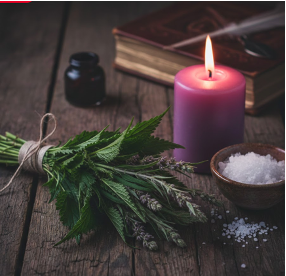
This ritual draws on the Germanic and Celtic traditions of herbal protection magic, especially the Anglo-Saxon practice of wortcunning (herb-craft) found in texts like the Lacnunga manuscript (Pettit, 2001). The combination of willow and nettle for boundary work reflects ancient understanding of these plants’ protective qualities, with willow associated with lunar magic and emotional boundaries, whilst nettles have long been recognised as powerful guardians against malevolent influences (Baker, 2011).
The timing follows the traditional Celtic understanding of lunar phases for magical working, where the waning moon is banishing and the waxing moon signifies building and strengthening (Hutton, 1999).
Materials Required
Fresh or dried hoary willow herb (Epilobium parviflorum)
Fresh nettle leaves (Urtica dioica)
Sea salt or rock salt
White or purple candle
Small cloth pouch (preferably linen or cotton)
Journal for recording observations
The Nine-Day Cycle
Days 1-3: The Banishing Phase (Waning Moon)
Begin three days before the new moon. Each evening at sunset, prepare a bath by steeping two handfuls of hoary willow herb in boiling water for twenty minutes. Strain the liquid and add to a warm bath along with a handful of salt. Light the candle and turn off all other lights. Use the candlelight to focus your energy and intention
As you enter the water, speak these words adapted from Anglo-Saxon protective charms (or find your own way to express out loud the same sentiments):
“Waters of willow, wash from me all that binds and weakens. Let flow away what is not mine to carry. By moon’s waning, I release what harms.”
Remain in the bath for at least fifteen minutes, visualising unwanted energies and psychic intrusions flowing away from your body into the water. Upon rising, do not towel dry immediately but allow the herbal water to air-dry upon your skin. Put out the candle.
Day 4: The New Moon (Day of Silence)
On the new moon, observe a day of quiet reflection. Take a cup of nettle tea in the morning and the willow bath in the evening (ideally during the hour after twilight but it can also be later. Speak no ritual words. This is the void from which new growth emerges. Use this day to contemplate what boundaries you wish to establish and strengthen. Do not light the candle and if you can, take the bath in darkness.
Days 5-9: The Building Phase (Waxing Moon)
As the moon begins to wax, the ritual shifts from banishing to building protective barriers. Continue the daily nettle tea and evening willow baths, but now add this invocation (or anything similar that reflects the sentiment and fits you better) whilst in the bath:
“Willow strong and nettle bright, weave around me walls of light. What I allow shall enter here, what I forbid shall not draw near. By waxing moon and rising power, strengthen now my sacred tower.”
Repeat the chant 9 times.
On the final day (Day 9), after your bath, take a small amount of the dried herbs and place them in your cloth pouch. Carry this with you or place it in your living space as a continuing charm for boundary maintenance.
Historical Precedents
The practice of herbal baths for spiritual cleansing appears throughout European folk tradition, The nine-day cycle echoes the Germanic tradition of working magic in cycles of nine, as seen in the Nine Herbs Charm from the Lacnunga (Pollington, 2000). Nettle’s protective qualities are documented in numerous folk traditions, including the Scottish practice of carrying nettle to ward off curses (McNeill, 1957), whilst hoary willow’s association with lunar magic and emotional healing appears consistently in Celtic herbalism (Grieve, 1971).
Closing Notes
This ritual may be repeated at each lunar cycle as needed. The combination of physical cleansing through bathing and internal strengthening through herbal consumption creates a holistic approach to boundary establishment that honours both ancient wisdom and practical application.
References
Baker, M. (2011). Discovering the Folklore of Plants. 3rd ed. Oxford: Shire Publications.
Grieve, M. (1971).A Modern Herbal. New York: Dover Publications.
Hutton, R. (1999). The Triumph of the Moon: A History of Modern Pagan Witchcraft. Oxford: Oxford University Press.
McNeill, F.M. (1957). The Silver Bough: Scottish Folklore and Folk-belief. Glasgow: William MacLellan.
Pettit, E. (2001). Anglo-Saxon Remedies, Charms and Prayers from British Library MS Harley 585. Lewiston: Edwin Mellen Press.
Pollington, S. (2000). Leechcraft: Early English Charms, Plantlore and Healing. Hockwold-cum-Wilton: Anglo-Saxon Books.